The city centre was in 1987 by the Law of the Slovak National Board proclaimed a Protected Urban Area. It consists of the Square of Virgin Mary, a square 100x100 m, and the adjacent 9 streets opening to it, and further 12 streets situated around the square.
The Square of Virgin Mary is typical by its houses with their first floors facing the square protruding and roofing the streets, thus making arcades called commonly "laubne". The houses containing shops and craftmen's workshops have until now well preserved original gothic cellars. The origin of the square goes back before the year 1300. Since the fire in 1886 all the houses have gable roofs. These, thanks to the support of the city of Žilina, are being gradually reconstructed.
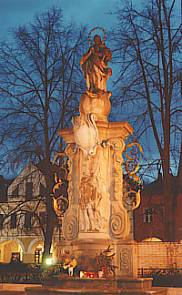
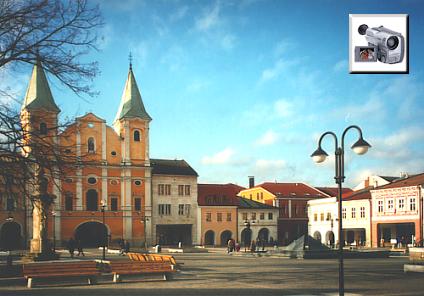
The statue of Immaculata in the Square of Virgin Mary
In the middle of the square is the statue of Immaculata erected in 1738 in honour of recatholization. The statue is placed on a pedestal with the relief of St. Florian, the patron of firemen. Within the reconstruction of the square also the two historical wells have been reconstructed with water surface in the depth of about 12 m.
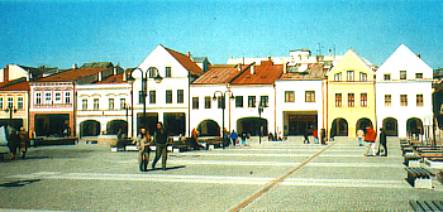
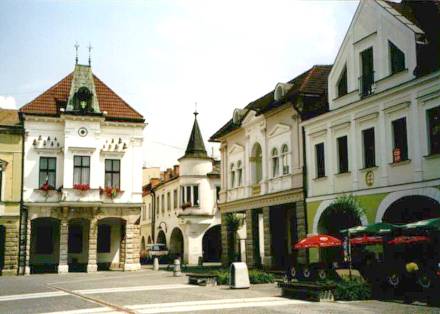
The Square of Virgin Mary
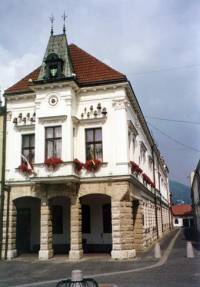
The house No.1 in the Square is the Town Hall of Žilina on its east side, though the entrance gate to the building is from Radničná St.
|
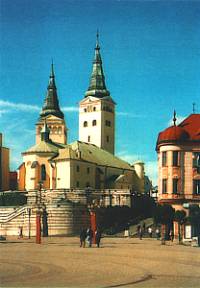
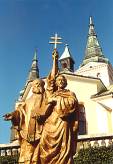
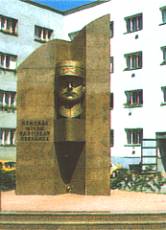
The Town Hall was subjected to several rebuildings. Its today's shape is from 1890. The last reconstruction was realised in 1992 and 1993. Also the Town Hall has original gothic cellars. The Town Hall is the seat of the Mayor and prides of representative halls where the meetings of the City Council and wedding ceremonies are held. In the ground floor a bust of Andrej Hlinka is placed (1864-1938), a Roman Catholic priest and an important personality of the Slovak national movement. Its stand bears verses of the poem by Andrej Žarnov. Interesting is a glockenspiel on the building facade, which since 1994 chimes melodies every top of the hour. On the western side of the Square are excelling the Roman Catholic Church of St. Paul the Apostle, and the Jesuite Monastery. The church was completed in 1754. The two-towered, baroque building roofs only a single nave without aisles. The towers are 32 m high. The main altar is built in baroque, and the picture of St. Paul is by a well-known Slovak painter Jozef Božetech Klemens (1817-1883). On the Monastery is a memorial tablet commemorating the bishop of Nitra Jozef Vurum (1763-1838). An important relic on the border of the protected Area is a Roman Catholic Church of the Holiest Trinity built about 1400. On its place most probably stood the Žilina Castle already as early as in the 13th century. Nave and two aisles were originally gothic, after the reconstruction they bear Renaissance features. The church tower is 51 m high, and the main altar is from 1697. Of great value are pictures on the altars by J.B.Klemens. On the church is a memorial tablet to the memory of the church's reconstruction in 1942. Beside the church is the Burian's Tower, 46 m high. This Renaissance tower was erected in 1530. The view of both towers from the Square of Andrej Hlinka is the most typical view of our town - the symbol of Žilina. It appears often in picture post-cards, in various publications, and also in postal stamps edited in 1997. Near to the church is the former Representative House - the today's seat of the City Theatre, Radio Žilina and Television Žilina. The building was completed in 1944 during the administration of the Mayor Vojtech Tvrdý (1896-1963). At that time also the balustrade was built of the today's shape as well as the Parish Steps which together with the Parish Street form connecting communication between the two main squares of Žilina. Statute of St. Cyril and Metod |
|
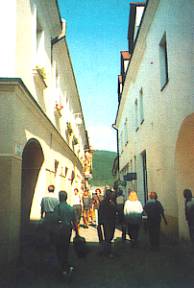 Parish Street
|
|
|
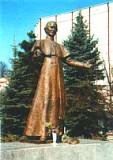
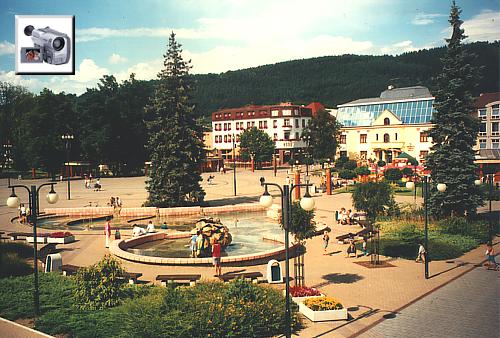
The second important square is the Square of Andrej Hlinka situated below the terrace of the Váh River. In it is the statue of Andrej Hlinka, unveiled in 1994, by the Žilina sculptor Ladislav Berák. The stand bears an inscription reading - Andrej Hlinka, Father of the Nation. Pleasant atmosphere of the square is maintained by the stepwise fountain. The square is a suitable place for various cultural events.
In the square is the building which roofs the Považská Gallery of Arts with memorial tablet commemorating the expositions of paintings in 1903, and the largest department store Tesco (the former Prior). The square continues to the recently reconstructed oldest Žilina City Park (1902-1908), the Orchard of the Slovak National Uprising with music pavilion and a fountain with the statuary by Vladimír Kompánek.
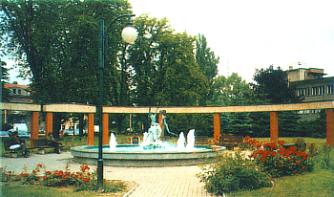
The Orchard of the Slovak National Uprising
From the Sq. of Andrej Hlinka through the National St. there is an access to the Railway Station. The mentioned square and the National St. were reconstructed in the first phase of reconstruction of pedestrian zone after 1990.
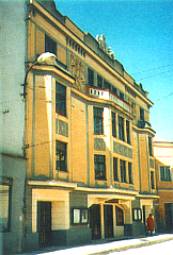
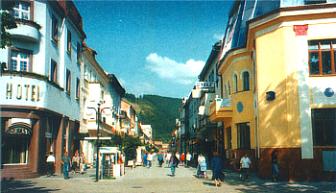 National Street It roofs the State Chamber Orchestra (ŠKO). In this building, the former cinema (Grand Bio Universum) in 1921 took place the premiere of the first Slovak film played by persons Jánošík. Both events, the foundation of ŠKO and the premiere of Jánošík are commemorated by a memorial tablet on the House of Arts |
|
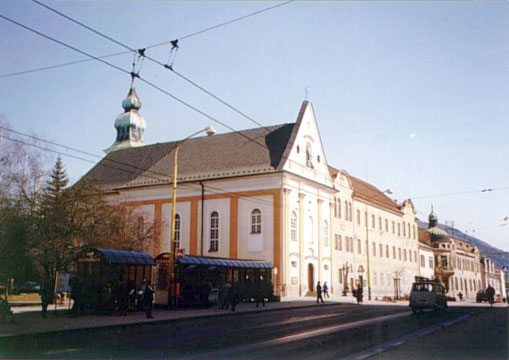
The Church of St. Barbara and Franciscan monastery
Opposite the church there is a former Financial Palace (the today's main office of the First Communal Bank) and the Bacher's villa where on 12 December 1918 the Ministry for the Management of Slovakia started working which is commemorated by a memorial tablet on the building. An important building in Hurbanova St. is the secession Rosenfeld's Palace - the today's Centre of Spare Time - Spectrum.
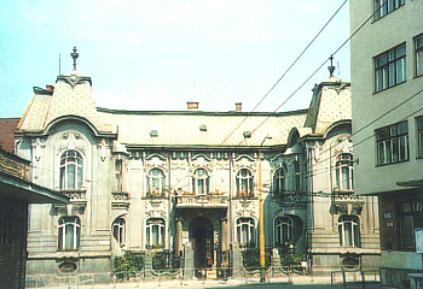
Rosenfeld's Palace
Opposite to it is a building of former synagogue - the today's Cinema Centrum. It was designed by the German architect Prof. Peter Behrens. Nearby is the secession building of the University of Žilina (the former secondary school) and a Catholic House built in neo-classical style. This building roofed formerly a theatre, later a cinema, and today it is a seat of the Gymnasium of St. Francis of Assisi belonging to Catholic Church.
|
|
|
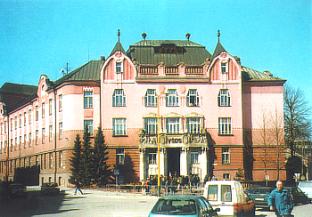
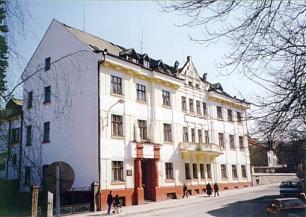
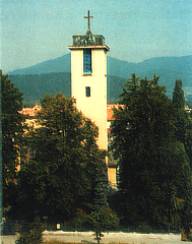
| In this part of the city is situated the Evangelic A.c. Church built after the design of the architect Michal Harminc. In this church there is a memorial tablet commemorating the life of Evangelic bishop Fedor Ruppeldt (1886-1979), who acted in Žilina. Behind the border of the Urban Protected Area, to the south is an impressive building from 1988 the seat of City Office of Žilina. In front of it is a memorial to the victims of communist regime - the only one in Slovakia. It was unveiled in 1998. In the Square of Ľudovít Štúr there are two large buildings - the Trade Union House of Culture, and the largest hotel in the city - Slovakia. The square continues to the oldest residence quarter of Žilina - Hliny and the Street of Anton Bernolák called popularly Bulvár. At the end of this street is the Regional State Library possessing more than 300,000 items.The Library enjoyes more than Evangelic church 19,000 regular readers. The number of lended books is more than 900,000/year. |
|
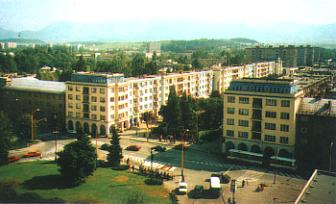 The Street of Anton Bernolák (Bulvár) |
|
Near the Orchard of Peace on Bôrik there is the Indoor City Swimming Pool which had been opened in 1963 as the first 50-meter Olympic swimming pool in Slovakia, with swimming pools in the open, too. The swimming pool was in recent years totally reconstructed, and reopened for the public in 1997. Beside it is a unique wooden structure - The Sports Hall at Bôrik, housing many important international sport events, concerts and exhibitions. The hall houses also the volleyball and basketball league and many tournaments. Each year the hall is the venue of the tournament festival in minibasketball of the youth BADEM. Nearby are several tennis courts of the Tennis Club Žilina and a modern indoor shooting centre.
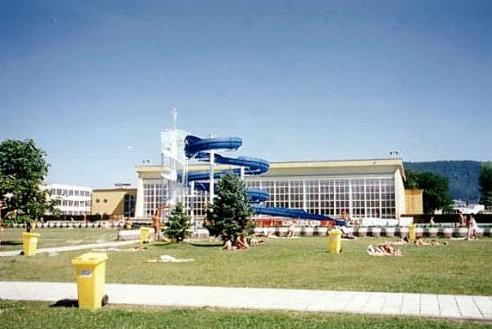
City Indoor Swimming Pool
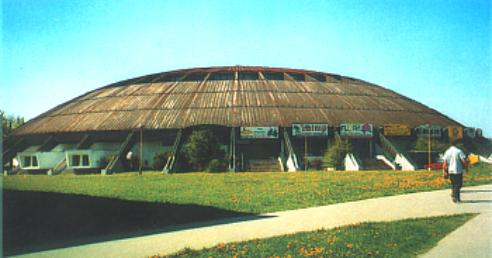
Sports Hall
Beside the Sports Hall is the House of Technique with a lot of exhibitions installed there every year - e.g. Expotour-Slovakia (the fair of tourist traffic), Sympomech - Expostavmat (building), and T.I.S. (telecommunications). Near the Orchard of Peace is the area of the Sport Club Stavbár (sports hall, fitness centre, hotel).
In the quarter Veľký Diel the vast area of the University of Žilina stretches with lecture halls, laboratories, dormitories and social facilities. Nearby is the so-called Paľová búda - a University centre for pastoration.
In the vicinity of the University area is a forest park Chrasť covering about 70 hectars. The forest park between the quarters Vlčince and Solinky is a popular area for resting and recreation. It provides oportunities for sports (jogging, cross-country skiing). On its edge is a chapel erected to the memory of the Žilina citizens fallen in the World War.
In Solinky quarter is a church consecrated to the Good Shepherd, which construction thanks to the voluntary workers and substantial support of the city, lasted exactly one year. In May 1999 the church was consecrated by Ján Chryzostom, Cardinal Korec.
| The oldest architectural relic in Žilina is the Church of St. Stephen the King in the quarter Rudiny. The origin of this late-Romanesque church is dated by the experts to the years 1200-1250. The legend goes that the Hungarian King Stephen I himself (958?-1038) ordered to build it. Valuable is the inner decoration of the church. Wall paintings originate form approximately 1260; in 1950 they were discovered and later on restored by the Žilina fine artist Mojmír Vlkoláček. The church is walled by a stone fence. Archaeological survey made in 1995 and discovered foundations of the Chapel of Corpus Christi from the 15th century, which were until then documented only in writings. An important artistic relic of Žilina is Budatín Castle situated at the confluence of Váh and Kysuca rivers. As a sentinel castle it was built in the 13th century. The oldest part of it is a round tower, 20 m high, 12 m in diameter, and the walls 2 m thick. Today the castle houses the Považské Museum with the exhibitions of history of Žilina, history of archaeology and the tinkers' craft. To the castle belongs also a historical park |
|
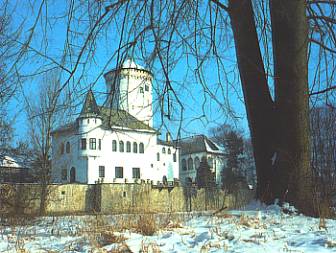
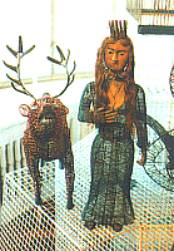
Budatín Castle with the tinker exhibition
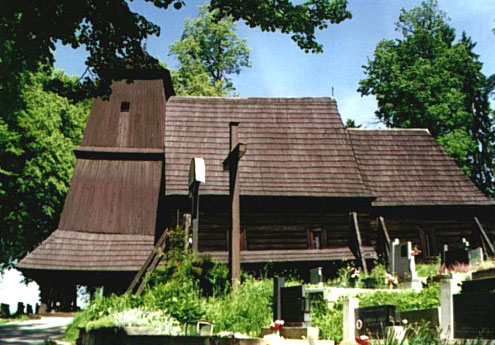
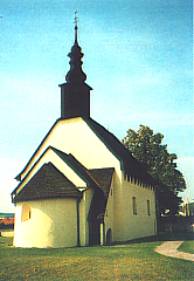
The Church of St. Juraj in
Trnové
An important construction in east part of the town is the Žilina Dam constructed by Váhostav Žilina. This enterprise is important for the energetic system of Slovakia and anti-flood defence system of Žilina. It has already rescued the town from the flood in 1997 - still before its completion. The production of electric energy employs the water gradient 24.8 m on two Kaplan turbines. The installed output of the turbines is 72 MW, and the station produces 173 GWh of electric energy per year. The turbines are made in Austria (VOEST Alpine Linz) and the generators in Italy (ABB Milan). The area of the dam lake covers 2.55 sq. km. The water works are the best viewed from the lookout terrace at the roadside of the E50 road. In a short future good opportunities for water sports will be created here.
Not far away from the Žilina Dam is the newly built village Mojšova Lúčka constructed for those who had to move out from the dam's building site. The second part of new houses is in the town quarter Rosinky. Altogether 136 new family houses have been built.
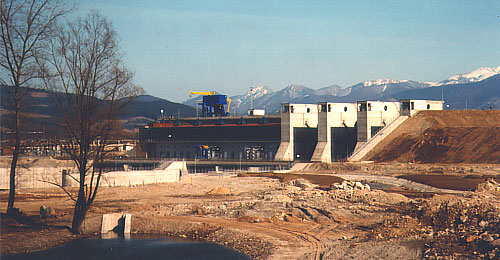
Water Dam Žilina
Text: Dr.Ján Štofko © 2001
